
Updating...
Your wish list is empty.
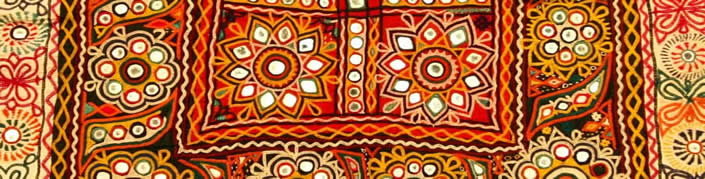
This gallery features some of our extraordinary collection of new and antique textiles from India and around the world.
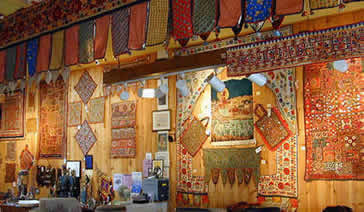
Indian textiles on display at The Magic Carpet
For millenniums, India has produced sophisticated textiles and with its’ location on the Silk Route they have been traded throughout the world. In India, textiles are to be found everywhere. They were made for the family to wear, for adorning animals and homes, for religious ceremonies, festivals, births and dowries. These embroideries were a significant part of the traditional way of Indian culture. Two of the most sacred old texts of India, The Ramayana and The Mahabharata, speak to how these textiles were used over four thousand years ago.
The most commonly used background fabric is woven cotton with embroidery thread of cotton, silk, wool, silver and gold. The present day Indian states of Gujarat, Rajasthan, and Andhra Pradesh, which are particularly arid, desert regions, make some of the finest and brightest needlework textiles in the world. It is said: The harsher the environment, the harder the life, the brighter the color, the greater and more intricate the craft. The women of the State of Gujarat, particularly, are known for their prolific and exquisite embroideries. The finer the embroideries the higher the status of the woman in her husband’s family.
There are more than twenty different communities each with their own style, designs, weaves, colors, symbols and size of mirrors. Some of the most well-known of these embroidery communities are: The Kambi (farmers), the Mahajan (merchants), the Ahir (said to be descendants of Krishna and sellers of milk and cheese) the Rabari (herders of sheep and camels), Mochi (cobblers) and the Kathi (land owners).
This beautiful art form flourished until India’s independence in l947 when there was a tremendous decline in quality and production. This was due to the intermingling between the different groups thus causing the breakdown of tradition as well as women beginning to work elsewhere and no longer having enough time. Most recently with the introduction of television and the Internet there has been even a larger decline. Fortunately, there are now cultural survival projects going on that are revitalizing the creative genius of this ancient art form.
Although these old embroideries are no longer available in the markets of India today, part of this collection is available here on our web site, which we encourage you to peruse.
The Magic Carpet has, over a 30-year period, put together a museum-quality collection of rare ceremonial and dowry embroideries particularly from the Kutch and Suarasthra regions of Gujarat. Most of these extraordinary pieces are 60 to 100 years old and in superior condition. The bulk of our collection is available off-line at The Magic Carpet Oriental Rug Gallery in Nevada City, California. If you are looking for a particular piece, please contact us.
Paul and Eileen Jorgensen
Textile Glossary ~ Definitions of common textile types and terminology.